مطالب پیشنهادی از سراسر وب
۳ سال پیش
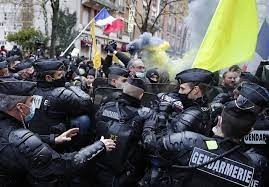
In an interview with Mats Nilsson an independent legal analyst
Beirag News deals with the recent events in France and discusses the French protests
Mats Nilsson looks at the causes of the recent protests in France and explains:«A government proposal to keep the pension system solvent as the life expectancy of the French has grown and birth rates have declined. But the majority rejected this narrative and wish for big companies or wealthier households to pitch in more to balance the pension budget instead. Also pension spending is not out of control it's relatively contained. And so the reform demanded needless sacrifices of the French, at a time when they are grappling with an inflation crisis and still recovering from the Covid pandemic. When the reform was later loopholed by macron to not pass parliament the protests were a given.»
He blames the French government and says:«I would argue that in France, the legitimacy of the power structure has collapsed; it is nownothing more than a coercive bloc. Having demolished all other mediations in bypassing parliament, Macron is separated from the people only by a police line. Nothing can be ruled out, for reasondeserted the leadership long ago.»
Nilsson considers the behavior of the French police against the protesters illegal and considers it a violation of human rights and explains:«It borders the illegal. Police are bound by law bu the footage out of France sends a clear signal that
Macron’s politics are in the process of dissolving the legal bounds of the police in France. From now on, power governs by roundup. The police will arrest anyone, including passers-by with no connection to the protest, scared men and women. A single message: don’t go out in the street, stay home, watch TV, obey. Here we see how Macron’s power can cling on only by force, when acts of force acquire disproportionate significance as well as being given a governmental a carte blanche for brutes in uniform.»
Nilsson says about the violent behavior of the police with the protesters:«The Interior Ministry gave the all clear to use a tough position from the start, and when power lets
loose its henchmen, two radically different results can follow: intimidation, or the tenfold
multiplication of rage. Upheavals occur when the first mutates into the second. There are many reasons to believe we’ve reached this stage in France. Antipathy towards the police promises to attain hitherto unknown breadths and depths. France’s human rights ombudswoman, Claire Hédon, and even the UN Special Rapporteur on Freedom of Association, Clément Voule, to each voice their concern about the heavy-handed policing as well as restrictions on people’s right to protest. Even the Council of Europe has become the latest body to condemn police’s “excessive use of force”.»
About France's contradiction of claiming human rights while using violent repression against protesters, Nilsson says:«Complex question. Policing and crowd control have hardened since the terrorist attacks of 2015,
becoming more aggressive and less inclined to negotiation, also in the equation are the protests on labor reforms in 2016 and the Yellow Vest unrest that started two years later. Protest movements with broad support without a clear structure or leadership are even harder to contain, but the authorities’ tendency to downplay cases of police abuse only encourages the more repressive elements in the force. Remember that France uses a special motorized unit known as the BRAV-M, whose baton-wielding officers are frequently accused of beating people at random be they protesters, bystanders or
journalists covering the rallies. Had this been in Tehran and the Iranian riot police and
plainclothesmen on their typical bikes doing the beating it would have been condemned by the EU. Now, nothing. This inability to critique France also emboldens Marcon to keep up the batons. Members of the BRAV-M are not trained to maintain public order and their actions often stoke tensions, including with riot police and gendarmes whose are the real specialists in this domain.»
Nilsson explains about the result of this demand of the French from the government:«Macron will try to invite to a dialogue with the moderate Unions in a bid to separate the united Unions. It may have worked before but hardly today. He can also sack his PM but that will only unleash a crisis of government. Remember that Macron is a Lame duck since ha can not run for president again. So in order to save his legacy he may well abandon the reform if the protests continue. I believe he will accept the demands of the protestors eventually. Suppression of such a broad opposition among a united public is in a sense impossible.»
Nilsson believes that these protests have the necessary capacity to overthrow the government. He explains further:«Maintaining public order is the most political of police tasks, coming directly under the control of the interior minister, which is a French peculiarity. It follows a nationwide strategy, which is why you see large-scale arrests everywhere and not at the discretion of local police forces. Heavy-handed policing stems from a crisis of authority desperately undermining Macron’s minority and deeply unpopular government, because when a government chooses force, it is always because its authority is weakened, and it may fall because of it.»
Nilsson evaluates the role of the Macron government in France's problems as important and says:«One must keep in mind that there are a host of more structural challenges facing France too. Top of the list are reforms of the workforce an overhaul of the pensions system, is only a part. Tackling France’s low labor participation rate, which drags on state revenues and speaks to the long-running challenge of developing a more highly skilled workforce, should also be a priority also an overhaul of the education system is needed. Businesses are also under stress from higher inflation.
Though inflation is lower than the eurozone average, soaring prices of raw materials and rising energy costs have hit French builders, car manufacturers and aviation companies hard. Industry has also been suffered from the snarling up of global supply chains
While France’s economic rebound has been stronger so far than that of other large European countries, it’s destructive sanctions policy towards Russia would have created chaos o matter what president in power.»
Nilsson points out the impact of these protests on the French economy and says:«Whether it’s the fight against inflation or the conditions of financing the economy, France appear to be in over their heads. The neoliberal radicalization unleashed by Macron’s elections have, in fact, only deepened the crisis of hegemony it was intended to resolve. The threshold crossed in the repressive crackdown, are evidence of a worsening crisis of the state economy. Macron’s image of unstoppable progress and needed liberal reform has been shattered. In this sense, Macron’s neoliberal modernization project is lost and no alternative, capable of consolidating a socio-political majority, has taken or will take shape under his rule.»
Beiragnews

فرم ارسال نظر
مطالب پیشنهادی از سراسر وب
 خرید حضوری و مطمئن ارز دیجیتال
 قالب های خاص سنگ مصنوعی
 دیگه نگو شام چی بپزم !! ○مجله آشپزی شکمو○
 تبلیغات افزایش بازدید و افزایش فروش در ارم بلاگ




 خرید حضوری و مطمئن ارز دیجیتال
مشاهده
خرید حضوری و مطمئن ارز دیجیتال
مشاهده

 وبلاگ بیرق نیوز