

 وبلاگ بیرق نیوز
۳ سال پیش
» I have a right too
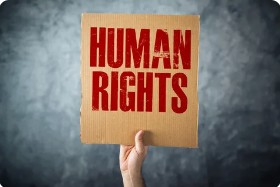
In an interview with Mats Nillsson, an independent legal analyst about human rights, Beirag News examines the issue of human rights in an article entitled "I
have a right too".
.At first, he defines human rights and to explain the subject, he states and explains its characteristics:«In my capacity of a legal historian, I define human rights as a set of norms in place to ensure widespread protection of individual citizens from arbitrary harm, presented based on two main sources. The first comprises customary and treaty-based norms in force in each state in accordance with constitutional procedures; the second exists at the national level and is represented by the constitutional charters containing public rights and freedoms. This latter source constitutes the legislative and judicial framework of national legal systems. Consequently, international human rights
law is now derived, like public international law, from a set of clear and precise rules located in various sources developed under the free will of states. Subsequently international human rights standards have become widespread and contain legal rules based on treaty or customary sources of international human rights law.»
Next, Nilsson considers one of the characteristics of human rights to be its universality and says:« I believe so. Governments were not coerced by the UN into creating the system. Their actions were voluntary since they were determined by national decisions and became universal. The argument invoked by those who now oppose universal rights, that the US and its European partners bashed the rest into acceding to the various treaties, vastly oversimplifies the power and influence of the West on this point; not least because we must remember that the US itself has avoided ratifying many of
the core human rights treaties. One can of course be extremely critical of human rights as universal, nut every country are still invested in the system. None of the 193 states has withdrawn. Threats to the principle of universality cannot however be brushed away easily because the broader international system itself remains vulnerable to the very same centrifugal pressures: extremism and go it alone nationalisms.»
In the continuation of his explanations, he confirms the instrumental use of human rights, but for a better understanding of the issue, he looks at the roots of human rights and explains:«Human rights have been central political to the liberal global order since the 1990s and is no longer a particularly effective way to bring around respected universal rules. The economic inequality and capitalist crisis have become more prominent. The political concept of Human Rights has been economically intertwined with the narrative of neoliberal governance. This has made the faith around human rights and the desire to promote them companions, at least chronologically, of the victory of neoliberal policies, which in turn meant expanding inequality in many places; the once revolutionary concepts of universal human rights, was refashioned to the western political idea of
freedom by tying it fundamentally to the free market and turning it into a weapon to be used politically against anticolonial projects all over the world.»
Nilsson points out the difference between countries that violate human rights and countries that respect human rights and says:«The argument can be made that almost every country violates human rights to a certain degree.Human rights are just being manipulated by states in the service of economic or strategic interests.
The hypocrisy is often so stark; for example the countries that rightly condemn the appalling violations of human rights in Syria or Venezuela, are the same ones who have remained silent over the violations in Yemen or Israel. The difference is in the draconian punishments that are in force in the different countries, but the violations of human rights are there, almost everywhere.»
Continuing to explain the nature of human rights, Nelson points out that the current human rights laws that govern the world arise from a specific culture and explains:«Universal and unique. Human rights have originated from a universal innate desire to preserve respect, equality, and the values of tolerance among peoples. This human desire is the later reflected specifically into national constitutions while additionally countries conclude international agreements to further the promotion and protection of the human rights. As an example, at the regional level, sixteen Arab states adopted the Arab Charter on Human Rights (ACHR) at the Arab Summit in Tunis on 23 May 2004. This agreement rendered the protection of human rights fundamental, whether originating from an international and universaö source in the form of international treaties, to from a national internal constitutional, legislative, or administrative human rights source.
Thereby sources of human rights have evolved on two levels, internationally and locally, to become a tool to guide judges when necessary, in order to safeguard human rights, and to enshrine those rules and principles of international human rights law enacted in national constitutional documents.»
Using the example of Palestine and Ukraine, Nelson points to the root of the difference in the impact of human rights and explains:«The laws are simply more effective in Ukraine because they are the laws of the Ukraine Rada. Palestine suffers for occupation and an inability to govern themselves and apply the jurisprudence of Palestine.»
Nilsson says about the reason why countries that support human rights support its violators, including the regime of Israel and Saudi Arabia:«Naturally. Human rights are today an integral part of realism power politics, and for the Western
world power and politics are outweighing any other considerations on human rights. While there can always be a discussion that can frame actions in different lights, there are major humanitarian concerns in the Kingdom and Israel that objectively raise issues pertaining to human security, and the responsibility of states.
While use of Saudi and Israel to strengthen a Western alliance in the Middle East, particularly in the face of an emerging BRIC+ bloc, there has never been a good precedent of propping up poor human rights actors to support a hypocritical Western grand strategy. This cold war-esque style strategy frames the hypocrisy in this case. While US foreign policy had been moving towards a more considered approach to human rights in the international community, it is still focused on playing
regional power politics, a dangerous precedent, particularly when any ally of convenience is not fully understood by Western decision makers.»
Nelson acknowledges the instrumental use of human rights and explains:«I believe in their instrumental use. However, laws are the creations of fallible human beings. They
might be good or bad, and so are always subject to interpretation and criticism in terms of independent moral principles. The international law of human rights, on this view, does not establish which human rights exist; instead, its goal is to implement moral rights we already possess, simply by virtue of our humanity. Slavery, torture, and gender discrimination did not suddenly become humanrights violations only when they were legally prohibited. It is the other way round: we have humanrights law in order to give force to human rights that in some sense pre-exist their legal recognition. Unfortunately, no consensus has yet emerged among philosophers or legal theorists, or politicians
or anyone else on how human rights are to be defended as objective truths, independent of law. But that is no reason to reject its instrumental application.»
In response to the question why countries like the United States of America and NATO members, who always talk about human rights, violate them widely.
says:«Imperial hubris. There is no way anyone can justify the double standards applied to NATO and human rights violations by appealing to transcendent moral principles. Cynical great-power interests are the only thing at stake. So, the best way to defend its continued moral transgressions has been for NATO to place it beyond debate altogether. Although NATO purports to be a ‘defensive’ alliance, this claim is contradicted by its destructive legacy – such as in Serbia, Afghanistan, and Libya, plus its everexpanding
global footprint. NATO’s claim to be the rules-based international order enforcer is not a view which is shared by most of the world. Support for the military alliance’s policies is almost entirely confined to its member countries and a handful of allies which together constitute a small minority of the world’s population. Most of the world’s population rejects NATO’s policies and global aspirations and does not wish to divide the international community into outdated Cold War blocs. Belief in the west’s moral superiority is not something that can be defended on rational grounds; it is an article of faith. And
there is nothing true believers hate more than a united new multipolar world that asks the fatal question: “Why?”»
Beirag News
۰ نظر / ۲۳۱ بازدید